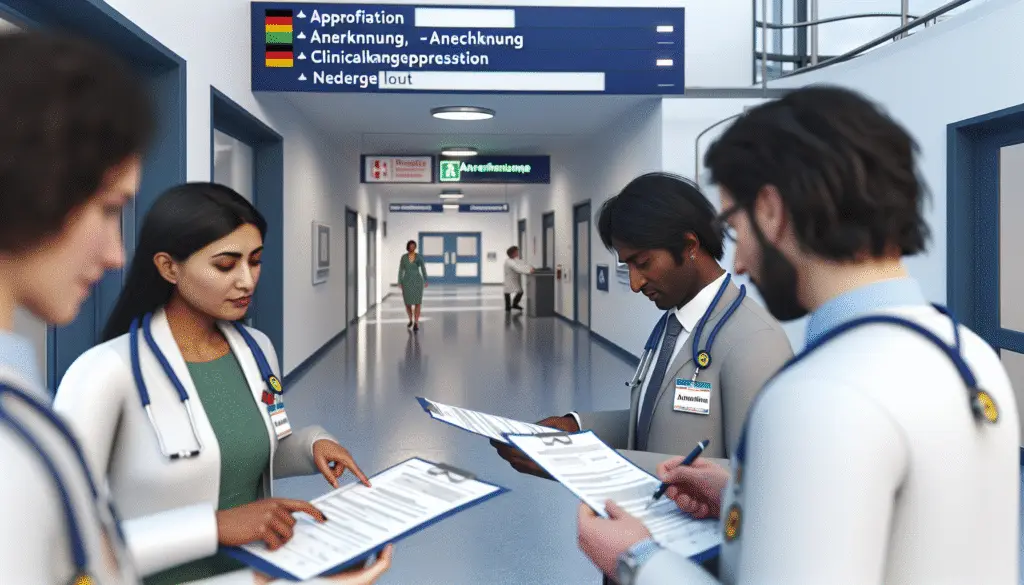
🩺 Approbation & Kenntnisprüfung in Germany
The Complete Guide for International Doctors – From Application to Full Medical License
Working as a doctor in Germany is an attractive goal for many international medical graduates. The German healthcare system offers excellent working conditions, competitive salaries, and strong professional development opportunities. However, medicine is a strictly regulated profession in Germany, and international doctors with non-EU degrees must navigate a specific pathway to obtain Approbation—the full, unrestricted medical license that allows you to practice independently.
⚠️ Important Note
Rules, procedures, timelines, and fees vary significantly between Germany’s 16 federal states (Bundesländer). Always verify current requirements with the competent authority (Approbationsbehörde, Landesprüfungsamt, or Landesärztekammer) in your chosen state. This article provides a general roadmap, not state-specific legal advice.
📚 Basic Concepts and Terminology
Before diving into the process, let’s clarify the key terms you’ll encounter:
- Approbation
- The full, permanent medical license in Germany. It allows you to work independently as a doctor without restrictions. Once you have Approbation, you register with the regional medical chamber (Landesärztekammer) and can pursue specialist training (Facharztausbildung) or work in any medical position.
- Berufserlaubnis
- A temporary, restricted medical license. It’s typically granted for a specific employer, position, and time period (usually 1–2 years, renewable). Many international doctors work under Berufserlaubnis while preparing for the Kenntnisprüfung and Fachsprachprüfung. However, it does not allow you to work independently or in all settings, and it’s not a substitute for Approbation.
- Kenntnisprüfung (KP)
- The medical knowledge exam for international doctors whose degrees are not considered fully equivalent to a German medical degree. It’s an oral-practical, case-based examination that typically focuses on internal medicine (Innere Medizin), emergency medicine (Notfallmedizin), and related fields. The goal is to demonstrate that your clinical reasoning, diagnostic skills, and therapeutic knowledge meet German standards.
- Fachsprachprüfung (FSP)
- The medical German communication exam, usually conducted by the regional medical chamber (Landesärztekammer). It tests your ability to communicate with patients, colleagues, and other healthcare professionals at C1 level, and to write clinical documentation such as discharge letters (Arztbrief). The FSP assesses practical language skills in realistic clinical scenarios, not abstract grammar.
- Approbationsbehörde / Landesprüfungsamt / Landesärztekammer
- These are the competent authorities that handle Approbation applications, administer exams, and regulate medical practice. The exact name and structure differ by federal state. Always identify the correct authority for your chosen Bundesland.
- Anerkennung (Recognition)
- The formal process of having your foreign medical degree evaluated and recognized as equivalent (or partially equivalent) to a German degree. This is the first step toward Approbation.
- Bundesärztekammer
- The National Medical Association, which represents all 17 regional medical chambers (Landesärztekammern). It provides general information and policy guidance but does not directly issue licenses or administer exams—those are state-level responsibilities.
📋 Step-by-Step Process for International Doctors
Here’s the typical pathway from initial research to full Approbation. Remember: exact steps, document requirements, and timelines vary by Bundesland.
1 Verify Your Degree and Eligibility
Check whether your medical degree is recognized in Germany. You can start by consulting the national portal “Anerkennung in Deutschland” (www.anerkennung-in-deutschland.de), which provides general guidance. However, the final decision is made by the Approbationsbehörde in the state where you apply.
2 Choose a Bundesland
You are free to choose any German state for your Approbation application. Factors to consider:
- Exam availability and waiting times for Kenntnisprüfung and Fachsprachprüfung
- Cost of exams and application fees
- Language of the authority (most communicate in German only)
- Job market and opportunities in that region
- Personal connections or family reasons
Research the official website of each state’s Approbationsbehörde or Landesprüfungsamt to compare.
3 Submit Your Application for Degree Recognition
Gather the required documents. Typical requirements include:
- Certified copies of your medical degree and transcripts (translated into German by a sworn translator)
- Proof of identity (passport)
- Curriculum vitae
- Proof of any postgraduate training or work experience
- Certificate of good standing from your home country (if applicable)
The authority reviews your application and determines whether your degree is equivalent. If not, they will inform you that you need to pass the Kenntnisprüfung to demonstrate equivalence.
4 Prove Your German Language Skills
You need:
- General German at B2 level (e.g., Goethe-Zertifikat B2, telc Deutsch B2, TestDaF, or DSH)
- Medical German at C1 level, usually demonstrated by passing the Fachsprachprüfung
Some candidates also take the telc Deutsch B2-C1 Medizin exam as preparation or as an additional certificate, but the FSP conducted by the Landesärztekammer is the standard requirement for Approbation.
5 Pass the Fachsprachprüfung (FSP)
The FSP tests your ability to:
- Conduct a medical history (Anamnese) with a patient (often a simulated patient or actor)
- Perform or describe a physical examination
- Present the case and suggest a diagnostic or therapeutic plan
- Write a discharge letter (Arztbrief) or similar clinical documentation
The exam is entirely in German and usually lasts 20–60 minutes, depending on the state. You must demonstrate clear, structured communication and appropriate medical terminology.
6 Pass the Kenntnisprüfung (KP)
The KP is an oral-practical exam where you work through clinical cases in front of examiners. It typically covers:
- Internal medicine (cardiology, pulmonology, gastroenterology, nephrology, endocrinology, etc.)
- Emergency medicine
- General surgery (basic concepts)
- Pharmacology and therapeutics
- Radiology and interpretation of diagnostic images
- Clinical guidelines (Leitlinien) and evidence-based medicine
Examiners assess your clinical reasoning, decision-making, patient safety awareness, and ability to work through cases systematically. The exam may last 45 minutes to 2 hours, depending on the state and format.
7 Receive Your Approbation
Once you pass both the FSP and KP (and meet all other requirements), the Approbationsbehörde issues your Approbation. You then register with the regional medical chamber (Landesärztekammer), which makes you a full member of the medical profession in Germany.
8 Next Steps: Work, Specialization, or Further Training
With Approbation, you can:
- Work in any hospital, clinic, or medical practice
- Begin specialist training (Facharztausbildung) in your chosen field
- Apply for positions with full contracts (no more temporary Berufserlaubnis)
- Pursue further qualifications, research, or academic medicine
💬 The Fachsprachprüfung (FSP) – Medical German Exam
🎯 Purpose
The FSP ensures that international doctors can communicate safely and effectively in German clinical settings. It’s not a test of grammar or vocabulary lists—it’s a test of real-world medical communication.
Typical Format
Although details vary by Bundesland, the FSP usually includes:
Doctor-patient conversation (Anamnese)
You interview a patient (often an actor) about their symptoms, medical history, medications, and social circumstances. You must ask relevant questions, show empathy, and structure the conversation logically.
Clinical documentation (Arztbrief)
You write a discharge letter or similar document summarizing the patient’s case, diagnosis, treatment, and follow-up recommendations.
Case presentation
You present your findings and reasoning to the examiners, who may ask follow-up questions or challenge your diagnostic approach.
Common Challenges
- Speed and fluency: You must speak clearly and quickly enough to cover all necessary topics in the time available.
- Medical terminology in context: Knowing the word for “myocardial infarction” is not enough—you must use it naturally while explaining risks, treatments, and prognosis to a patient.
- Cultural and communication norms: German patients expect clear, structured explanations. Examiners look for systematic history-taking and appropriate tone.
High-Yield Tips
- Practice Anamnese with native speakers or language partners. Use structured templates (e.g., OPQRST for pain, standard review of systems).
- Write Arztbriefe regularly. Study real examples from German hospitals and follow the standard structure (personal data, reason for admission, findings, diagnosis, therapy, recommendations).
- Learn handover phrases and clinical reasoning language: “Differentialdiagnostisch kommt in Frage…”, “Aufgrund der Befunde würde ich…”, “Zur weiteren Abklärung empfehle ich…”
- Record yourself speaking and identify gaps in fluency or vocabulary.
🧠 The Kenntnisprüfung (KP) – Medical Knowledge Exam
🎯 Purpose
The KP assesses whether your medical knowledge is equivalent to that of a German medical graduate. It focuses on core clinical disciplines, especially internal medicine, because these form the foundation of safe, independent medical practice.
General Format
The Kenntnisprüfung is typically:
- Oral-practical: You work through clinical cases in front of a panel of examiners (usually 2–4 doctors from different specialties).
- Case-based: You are given patient scenarios (sometimes with lab results, ECGs, X-rays, or other diagnostic materials)
- Interactive: Examiners ask follow-up questions, challenge your reasoning, or ask you to reconsider your approach.
Duration varies by state and university. Some exams last 45–60 minutes, others up to 2 hours.
Typical Subjects
🧠 Core Focus: Internal Medicine (70-80%)
- Cardiology: acute coronary syndrome, heart failure, arrhythmias, hypertension, ECG interpretation
- Pulmonology: pneumonia, COPD, asthma, pulmonary embolism
- Gastroenterology: liver disease, gastrointestinal bleeding, inflammatory bowel disease
- Nephrology: acute kidney injury, chronic kidney disease, electrolyte disturbances
- Endocrinology: diabetes, thyroid disorders
- Hematology/Oncology: anemia, common malignancies, anticoagulation
🚨 Other Common Topics
- Emergency medicine: shock, trauma, sepsis, life-threatening conditions
- General surgery: acute abdomen, appendicitis, cholecystitis, wound management
- Pharmacology: drug interactions, contraindications, safe prescribing
- Radiology: basic X-ray, CT, and ultrasound interpretation
- Psychiatry: depression, anxiety, somatization (sometimes included)
What Examiners Look For
- Structured clinical reasoning: Work through cases systematically (history → examination → differential diagnosis → diagnostics → therapy)
- Guideline-oriented thinking: Refer to German or European clinical guidelines (Leitlinien) when appropriate
- Patient safety: Identify red flags, contraindications, and situations requiring urgent intervention
- Communication: Explain your reasoning clearly in German
❓ Frequently Asked Questions (FAQ)
Who exactly needs the Kenntnisprüfung?
International doctors with medical degrees from non-EU countries typically need the KP if their degree is not considered fully equivalent to a German degree. The Approbationsbehörde makes this determination during the recognition process. EU-trained doctors usually do not need the KP, but there are exceptions.
Can EU-trained doctors also be asked to take the KP?
In rare cases, yes. If there are significant gaps in training or if the degree is not fully recognized, the authority may require additional exams. However, this is uncommon for standard EU medical degrees.
How many times can I repeat the exam?
This depends on the Bundesland. Most states allow 2–3 attempts for the Kenntnisprüfung and a similar number for the Fachsprachprüfung. After failing the final attempt, you may not be able to obtain Approbation in that state (or in Germany at all, depending on the rules). Always check the exact regulations with your Approbationsbehörde.
How long does the whole Approbation process take?
From initial application to final Approbation: typically 6 months to 2 years, depending on:
- How quickly the authority processes your documents
- Waiting times for exam dates
- Your language preparation time
- Whether you pass the exams on the first attempt
What level of German do I really need for everyday clinical work?
Officially, you need B2 general German and C1 medical German (demonstrated by passing the FSP). In practice, true fluency at C1 level is essential for safe patient care. You’ll be writing complex discharge letters, communicating with distressed patients and families, understanding rapid case discussions on ward rounds, and reading German-language guidelines. Don’t underestimate the importance of language—it’s as critical as medical knowledge.
What counts more: theoretical knowledge or communication?
Both are essential. You can fail the Kenntnisprüfung even with excellent medical knowledge if you can’t explain your reasoning clearly in German. Conversely, fluent German won’t save you if your clinical decisions are unsafe. Aim for balance: solid medical knowledge + clear, structured communication.
What are the most common reasons for failing the KP or FSP?
For the KP:
- Disorganized clinical reasoning (jumping between topics without structure)
- Lack of familiarity with German guidelines (Leitlinien)
- Inability to interpret basic diagnostic tests (ECG, X-ray, lab values)
- Poor communication (even if medical knowledge is correct)
- Ignoring safety issues or contraindications
For the FSP:
- Insufficient German fluency (slow speech, frequent pauses, incomplete sentences)
- Poor Anamnese structure (missing key questions, not exploring symptoms fully)
- Weak documentation skills (unclear or incomplete Arztbrief)
- Lack of empathy or inappropriate tone with patients
Can I work with a temporary Berufserlaubnis before the KP?
Yes, many international doctors do this. Berufserlaubnis allows you to work under supervision while preparing for the Kenntnisprüfung and Fachsprachprüfung. It’s often issued for 1–2 years and can be renewed. However, Berufserlaubnis is restricted to a specific employer and position, and does not grant full professional independence. Your long-term goal should always be Approbation.
How should I choose the Bundesland for my application?
Consider:
- Exam availability: Some states have shorter waiting times for KP and FSP
- Cost: Application fees, exam fees, and translation costs vary
- Language and support: Some authorities are more accustomed to working with international doctors
- Job opportunities: If you already have a job offer or connections in a specific region, apply there
- Personal reasons: Family, climate, cost of living, cultural fit
What are the typical costs?
Costs vary significantly by state. Typical expenses include:
- Application fee for Approbation: €100–€400
- Kenntnisprüfung fee: €400–€1,000
- Fachsprachprüfung fee: €300–€600
- Language courses: €500–€3,000+ (depending on intensity and duration)
- Sworn translations of documents: €50–€200 per document
- Travel and accommodation for exams (if you don’t live in that state)
Budget €2,000–€5,000 minimum for the entire process, plus living expenses during preparation time.
What is the salary as a doctor in Germany after Approbation?
Salaries vary by position, experience, and employer. As a rough guide:
- Assistenzarzt (resident physician) in a hospital: €4,500–€6,500 gross per month (before tax)
- Facharzt (specialist): €6,000–€8,000+ gross per month
- Oberarzt (senior physician): €8,000–€12,000+ gross per month
- Niedergelassener Arzt (private practice): Income varies widely
Check current Marburger Bund salary tables for hospital positions.
How do I stay motivated during this long process?
- Set small, achievable goals: “This week I’ll master acute coronary syndrome” instead of “I must learn all of internal medicine”
- Join communities: Connect with other international doctors preparing for the same exams
- Celebrate progress: Passing the B2 exam, finishing a course module, or writing your first complete Arztbrief are all wins
- Remember your why: You’ve already completed medical school and worked as a doctor. Approbation is the gateway to long-term career stability
📅 How to Build an Effective Study Plan for the Kenntnisprüfung
Preparing for the KP requires strategic planning. Here’s how to structure your preparation:
1. Prioritize Core Topics
Focus most of your time on internal medicine, because it forms the foundation of the KP in most states. Within internal medicine, prioritize:
- Cardiology (especially acute coronary syndrome, heart failure, arrhythmias, ECG interpretation)
- Emergency medicine (shock, sepsis, acute respiratory failure, trauma basics)
- Gastroenterology (GI bleeding, liver disease, IBD)
- Pulmonology (pneumonia, COPD, asthma, PE)
- Nephrology (AKI, CKD, electrolyte disorders)
2. Use Multiple Learning Methods
Combine:
- Video courses or lectures to build foundational knowledge and understand complex concepts in German
- Reading guidelines (Leitlinien) from AWMF or ESC to learn evidence-based approaches
- Clinical cases and questions to practice applying knowledge in realistic scenarios
- Arztbrief writing and case presentations to develop communication skills
3. Practice Clinical Reasoning in German
Don’t just memorize facts. Practice explaining:
- Why you chose a specific differential diagnosis
- How you would rule in or rule out a condition
- What diagnostic tests you would order, and in what sequence
- How you would explain a diagnosis and treatment plan to a patient
4. Create a Realistic Timeline
Typical preparation windows are 6–12 months. A sample 9-month plan:
Months 1–3: Focus on language
B2 general German, medical vocabulary building
Months 4–6: Deep dive into internal medicine topics
Cardiology, pulmonology, gastroenterology, etc.
Months 7–8: Emergency medicine, pharmacology, surgery basics, radiology
Month 9: Full case practice, mock exams, review weak areas
5. Balance Study with Work and Life
Avoid burnout:
- Set weekly goals, not daily marathons
- Take at least one full rest day per week
- Use clinical work (if you have Berufserlaubnis) as a learning opportunity
- Stay connected with family and friends for emotional support
6. Seek Feedback
Find ways to get objective feedback on your performance:
- Study groups with other international doctors
- Mock exams or practice sessions with colleagues who have already passed the KP
- Language exchange partners or tutors who can critique your Anamnese and Arztbrief
- Structured courses with assessments and instructor feedback
🎓 Where Structured Courses Like Kennti Fit Into This Process
After reading this guide, you may feel both informed and overwhelmed. The Approbation process is complex, the Kenntnisprüfung covers a huge amount of material, and doing it all in a second language adds another layer of difficulty. This is where structured, focused preparation can make a significant difference.
Kennti.com is an e-learning platform specifically designed for international doctors with non-EU medical degrees who are preparing for Approbation in Germany. It was created by doctors who went through this exact process, understand the challenges, and wanted to replace the chaos of random PDFs, Telegram summaries, and scattered YouTube videos with a clear, systematic learning path.
What Kennti Offers
📚 Kennti All-in-One – Masterkurs Kenntnisprüfung
A comprehensive video-based course covering the core topics of internal medicine and related fields, structured specifically for the KP format. It includes case discussions, exam-style questions, and detailed explanations in German medical terminology.
🎯 Focused Topic Courses
Individual modules on cardiology, pulmonology, emergency medicine, EKG interpretation, and other high-yield subjects. You can pick what you need or start with a complete package.
💬 Support for Fachsprachprüfung
While the main focus is the KP, the courses also help you develop clinical German language skills, understand how to write Arztbriefe, and practice case presentations.
When a Course Makes Sense
A structured course like Kennti is especially helpful if you:
- Feel lost in the volume of material and need a clear roadmap
- Want to avoid wasting time on topics that are rarely tested
- Benefit from video-based teaching and visual explanations
- Need to improve your medical German alongside your knowledge review
- Prefer systematic, step-by-step learning over self-directed chaos
Success Still Requires Active Work
Enrolling in a course is not a magic solution. You still need to:
- Watch the videos actively (take notes, pause and reflect, review difficult sections)
- Practice cases and questions regularly
- Seek feedback on your Anamnese and documentation
- Stay disciplined and consistent over months of preparation
Think of a course as a well-organized toolbox. It gives you the right tools in the right order, but you’re the one who has to build the house.
🔗 Useful Links & Contacts
📚 Official & General Information
Anerkennung in Deutschland (National Recognition Portal):
www.anerkennung-in-deutschland.de
General information on recognition of foreign qualifications, including medical degrees
Bundesärztekammer (German Medical Association):
www.bundesaerztekammer.de
Policy information, general guidance, and links to regional medical chambers
Marburger Bund:
www.marburger-bund.de
Information on salaries, working conditions, and rights of doctors in Germany
AWMF (Association of Scientific Medical Societies):
www.awmf.org
Access to German clinical guidelines (Leitlinien) across all specialties
🎓 Kennti Website & Courses
Main website:
https://www.kennti.com/
All courses:
https://www.kennti.com/alle-kurse/
Packages & bundles:
https://www.kennti.com/pakete/
Registration / Login:
https://www.kennti.com/anmelden
Contact page:
https://www.kennti.com/kontaktiere-uns/
📞 Contact & Support
Email: info@kennti.com
WhatsApp support: +49 15560 888011
WhatsApp support link:
https://wa.link/o9pimk
💬 Community
Free WhatsApp community for Approbation, KP and FSP:
https://chat.whatsapp.com/Ca7qgBkQ2QQIsWXrVIQDLh
Connect with other international doctors preparing for the same exams, share resources, ask questions, and support each other
📱 Social Media
Facebook:
https://www.facebook.com/FB.Kennti/
Instagram:
https://www.instagram.com/in.kennti/
Final Thoughts
The journey from international medical graduate to fully licensed doctor in Germany is challenging, but thousands of doctors have successfully completed it. The key is preparation: understand the system, build a solid study plan, develop your German language skills, and practice clinical reasoning in realistic scenarios.
Whether you prepare independently or use structured resources like Kennti, remember that success comes from consistent effort, active learning, and a willingness to seek help when needed. The Approbation and Kenntnisprüfung are not designed to stop you—they’re designed to ensure that all doctors in Germany meet the same high standards of knowledge, communication, and patient safety.
You’ve already proven yourself by completing medical school and working as a doctor. Now it’s time to prove it in German. Good luck, and stay focused on your goal.